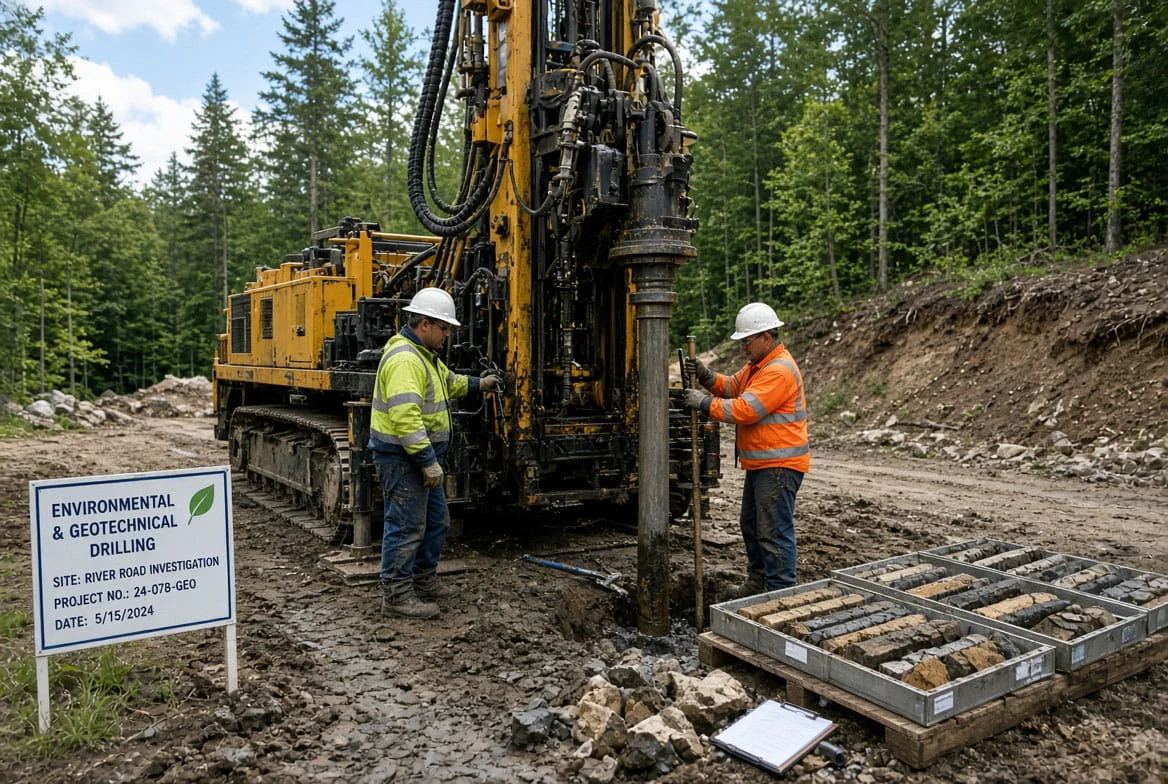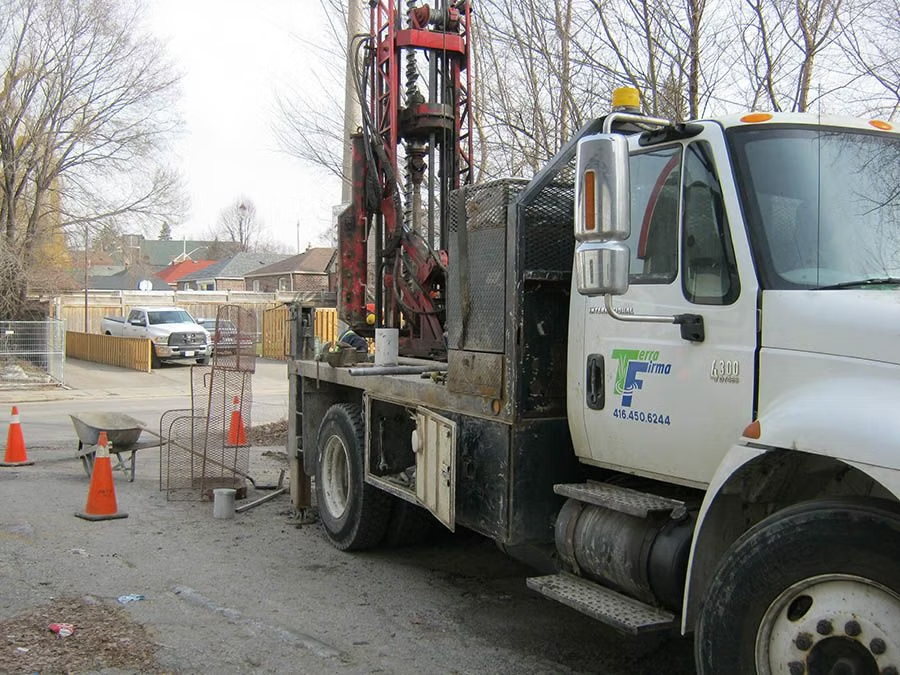
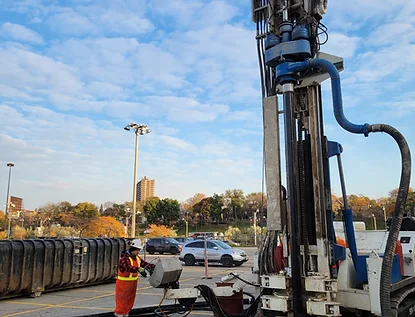
The drilling method is not a detail to leave to the contractor. It affects sample quality, how deep you can go, how much soil you generate, and what the job costs. Here is how the main options compare.
Most people commissioning a drilling program care about the result — the samples, the well, the borehole log. The method used to get there is treated as the contractor’s business.
It should not be. The method determines how good your samples are, how deep you can practically go, how much soil you have to manage afterwards, and how much of your budget the field work consumes. It is worth understanding the options.
Hollow-stem auger
A hollow-stem auger is a continuous flight auger with a hollow centre. The auger advances and stays in the hole as temporary casing, and sampling tools are run down the middle.
Best for: shallow to moderate depths in overburden — sands, silts, clays, and till without significant cobbles. It is the workhorse of environmental investigation in southern Ontario.
Advantages: no drilling fluid, so no fluid to dispose of and no risk of introducing water into the sample. Straightforward well installation through the augers. Widely available and economical.
Limitations: it will not advance through bedrock, and cobbles and boulders stop it quickly. Depth is practically limited, and sample recovery in loose saturated sand can be poor.
Sonic drilling
Sonic uses high-frequency vibration in the drill string, combined with rotation and downward force, to advance a core barrel through almost anything.
Best for: difficult ground — fill with debris, cobbles, boulders, and interbedded materials. Also strong where continuous, high-quality core is needed.
Advantages: near-continuous core recovery across almost every material type, including the loose saturated sands that defeat other methods. Faster in hard ground. Generates markedly less waste soil than augering, which matters when that soil has to be characterised and disposed of.
Limitations: a higher day rate, and the vibration can disturb the sample structure, which is a genuine concern for some geotechnical testing.
Air and mud rotary
Rotary drilling turns a bit at the bottom of a drill string, with cuttings carried to surface by either compressed air or a circulating drilling fluid.
Best for: bedrock, and deeper holes than auger methods will reach.
Advantages: depth capability and speed in rock. Mud rotary supports unstable formations while drilling.
Limitations: the returns are cuttings rather than intact samples, so discrete sampling requires additional tooling. Drilling fluid needs to be managed, contained, and disposed of, and on an environmental investigation the introduction of fluid needs to be considered carefully.
Direct push
Direct push hydraulically drives a small-diameter rod into the ground without rotation, recovering soil in a liner.
Best for: shallow environmental investigations, high-density sampling grids, and sites where a small footprint matters.
Advantages: fast, minimal disturbance, almost no waste soil, and the rigs are compact enough for restricted-access work.
Limitations: limited to relatively shallow depths in soft ground, and it stops at anything hard. Well installation options are limited by the small diameter.
Matching method to project
| Situation | Usual first choice |
|---|---|
| Standard Phase Two ESA in overburden | Hollow-stem auger |
| Historical fill, debris, or cobbles | Sonic |
| Continuous core needed for full depth | Sonic |
| Deep boreholes or bedrock | Rotary |
| Dense shallow sampling grid, tight site | Direct push |
| Geotechnical borehole with SPT and undisturbed samples | Auger or rotary |
Two things people get wrong
Assuming the cheapest day rate is the cheapest job. A method with a lower day rate that advances at a third of the speed through the ground you actually have is not a saving. Neither is a method that generates three times the waste soil on a site where that soil has to be tested and hauled.
Not telling the contractor what the samples are for. Geotechnical strength testing, contaminant analysis, and grain size testing have different requirements. If the drilling contractor knows what the samples need to support, the method and the sampling tooling can be selected accordingly.
Ask before you commit
If you are unsure which method suits your site, send the location and what you know about the subsurface — previous investigation reports, borehole logs from adjacent projects, or simply what the property was used for. We run several methods in house, so the recommendation is based on the ground rather than on which rig is sitting idle.
Details of our drilling services are on the site, or you can request a quote with your site information.