Ground source heat pumps are attractive on paper. The part that decides whether a project works is the borehole field — the approvals it needs, the ground it goes into, and the space it takes.
Interest in ground source heat pumps in Ontario keeps climbing, driven by electrification targets, energy costs, and the operating economics of large buildings. The heat pump equipment is the part people research. The part that determines whether the project is viable is the borehole field.
Here is what installing one actually involves.
What a vertical closed loop is
A vertical closed-loop system circulates fluid through sealed pipe loops set in boreholes drilled into the ground. In winter the fluid picks up heat from the ground and delivers it to the building; in summer the process reverses and the ground absorbs heat from the building.
The boreholes are typically a few hundred feet deep. A single-family home might need one or two. A commercial or institutional building can need dozens.
Nothing is extracted from the ground and nothing is discharged into it. The loop is sealed, which is the defining difference from an open-loop system that pumps groundwater.
The approvals
Vertical closed-loop ground source heat pump systems in Ontario are regulated, and the requirements changed with O. Reg. 98/12.
If the vertical closed-loop system extends more than five metres below ground, an Environmental Compliance Approval from the Ministry of the Environment, Conservation and Parks is required, including a work plan. Since practically every vertical loop goes considerably deeper than five metres, this applies to essentially all of them.
Horizontal closed-loop systems and direct exchange systems that stay shallower than five metres are exempt from the ECA requirement — but a municipal building permit is still needed for any earth energy system.
Some other requirements worth knowing:
- Hazardous gas encountered during construction must be reported immediately, and there are rules for managing it.
- Methanol is prohibited as a heat transfer fluid.
- Systems are expected to conform to the CAN/CSA-C448 standards — C448.1 for commercial and institutional, C448.2 for residential.
- Open-loop systems, which do involve a well, fall under the Wells Regulation, Reg. 903, and a Permit to Take Water may be required depending on the volume withdrawn.
If you are considering an open-loop system rather than closed-loop, the regulatory picture is different and considerably more involved. Confirm the requirements for your specific configuration with MECP before committing to a design.
What the drilling involves
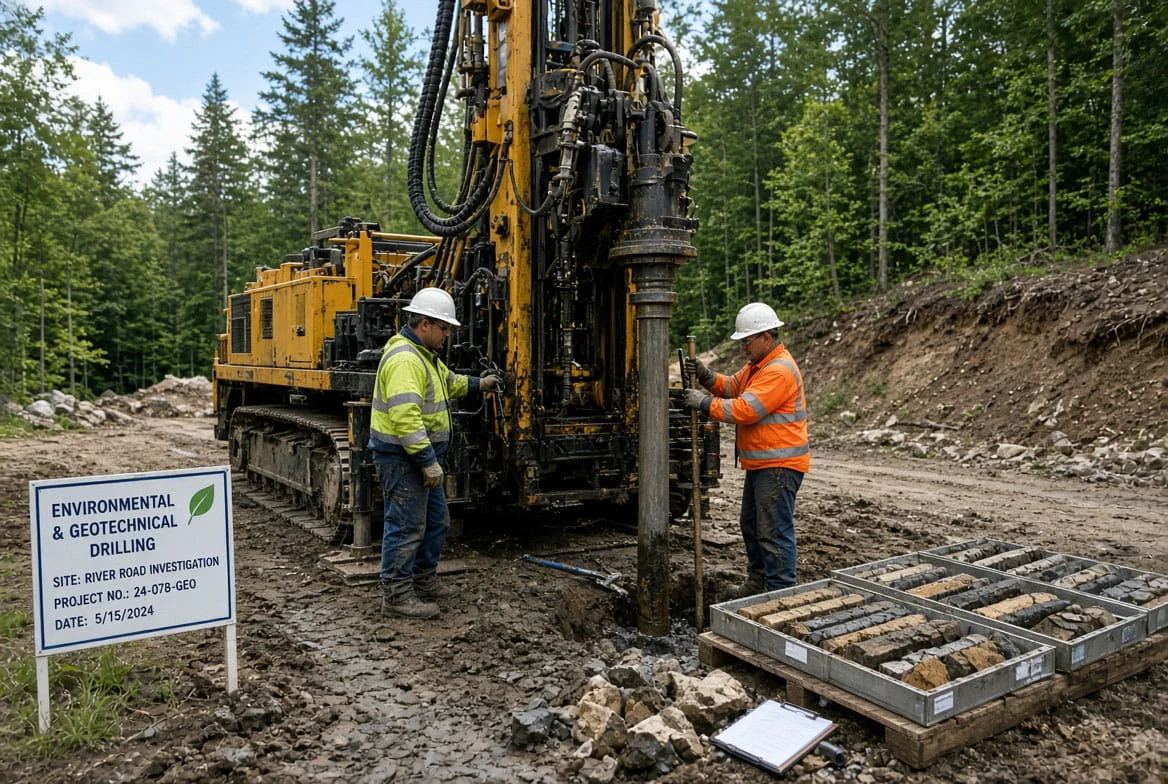
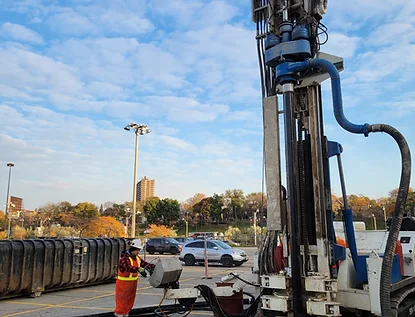
Space. This is the constraint that kills more geothermal projects than anything else. Boreholes need separation from each other so that adjacent loops are not competing for the same heat, and they need to sit clear of foundations, services, and property lines. A commercial field needs a genuine open area — usually a parking lot, a landscaped zone, or the building footprint before construction starts.
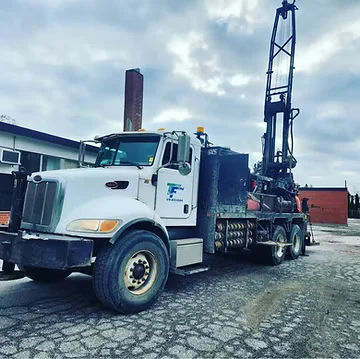
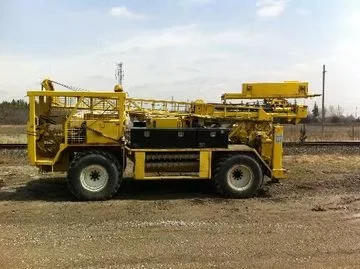
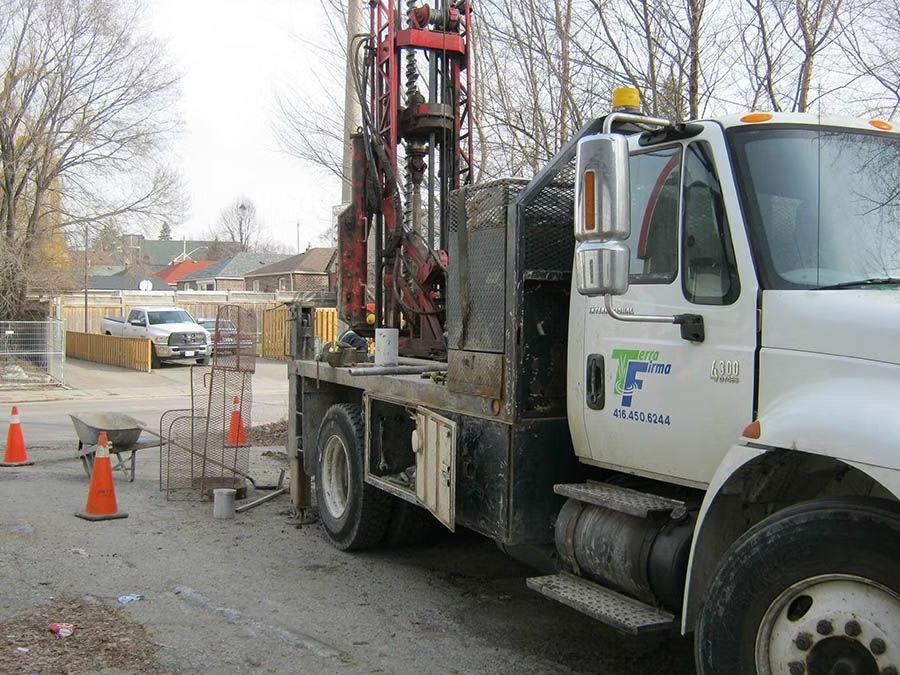
Access. A geothermal rig is not a small machine, and it needs to reach every borehole location, with room to handle drill string and loop pipe.
Ground conditions. Depth and drilling rate are governed by what is underground. Shallow bedrock is often good news for a geothermal field — rock conducts heat well and holds an open hole. Deep overburden with running sand is harder and slower.
Grouting. After the loop pipe goes in, the borehole is grouted from the bottom up with thermally enhanced grout. This does two jobs: it transfers heat between the loop and the surrounding ground, and it seals the borehole so that it cannot become a pathway between water-bearing layers. Grouting is the step where quality separates a field that performs from one that underdelivers for thirty years.
Headers and connection. Individual loops are run to a header, and the header is connected to the building mechanical room. Loop connections require the appropriate licensed trade.
The timing that catches people out
New construction is far easier than retrofit. On a new build, the boreholes go in before the site is paved and while there is room to work. On a retrofit, you are drilling around an occupied building, live services, and existing surfacing — and reinstating everything afterwards.
If geothermal is under consideration for a new project, the borehole field should be on the drawings at the same stage as the foundations, not added later.
Getting a realistic assessment
The honest answer for some sites is that the field will not fit, or that the ground conditions make the drilling cost outweigh the operating saving. Better to establish that early.
We drill geothermal borehole fields across Toronto and the GTA. Send us the site, the building load if the mechanical design has progressed that far, and any subsurface information you already have, and we will tell you what is realistic. Request a quote here.
Approval requirements change. Confirm the current requirements for your project with the Ministry of the Environment, Conservation and Parks.